onHand
A two-sided marketplace pairing security-checked volunteers with older people who need low-level help. I joined an 18-month trial, led the rebrand away from the word 'care', and rebuilt the volunteer background check into a pipeline: hundreds of pounds per checked volunteer down to about thirty.
An 18-month trial that couldn’t sign anyone up
onHand started life as ShareCare, a marketplace for low-level care: the unglamorous, genuinely useful stuff like a hand with the shopping or changing a lightbulb, delivered by local, security-checked volunteers for a small fee.
Eighteen months into a trial it could acquire people on either side - but with a difficulty and expense that threatened growth.
Part of the answer was that the whole thing ran on charity-land instincts: lots of caution, lots of paperwork, lots of manually checking people, lots of chatting before anyone was allowed to help anyone.
And when a match did happen, “matching” was really a person texting to ask if you were free, and when. It was, essentially, arranging meetings for strangers by hand, forever.
The word was the problem
I joined to lead the redesign once the founders had decided on a rename, a rebrand, a move to mobile and a full service overhaul. So we went and listened: user interviews, stopping people on the street, talking to people in our building, talking to carers and to people receiving care through the charities.
The thing that surfaced was the word “care.” Ask anyone about it and the picture in their head is the heaviest possible version: people in care homes, unable to live independently, completely isolated. Unfair and stigmatising, and ultimately not their fault for thinking it - this is just the culture we exist in.
Worse: we didn’t even serve those people! Their needs were far greater than our volunteers had signed up for, and they’re already served by huge care providers on a national scale.
So “care” was doing the worst possible job, scaring off the people we could actually help while drawing in the ones we couldn’t. The rebrand to onHand moved the focus from “care” to volunteers and readiness, and the people we wanted finally stopped flinching at the front door.
Ninety per cent off a background check
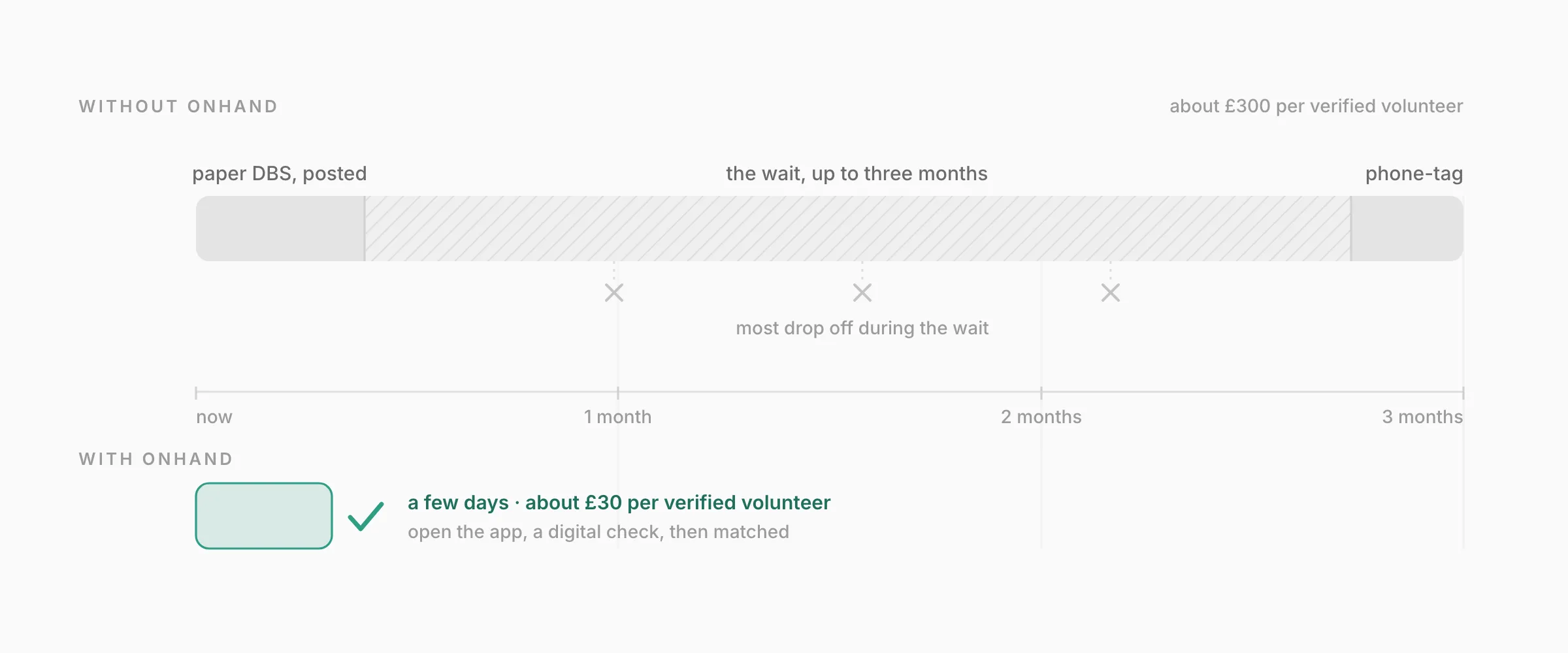
The other thing strangling the service was the DBS check, the UK’s criminal-record check. As it stood it was paper, written then posted, with a wait of up to three months before anyone could start.
We rebuilt acquiring a checked volunteer into a pipeline and squeezed three things at once. Batching the checks in particular areas at particular times freed our staff from sitting one-to-one with each applicant, so they could spend their time on acquisition instead.
Keeping people engaged in the app through the wait (rather than radio silence until a flat “yes” or “no”) meant far fewer dropped out, so more of every thousand who started actually finished.
And digitising the check itself lifted a mountain of manual effort off both sides. The cost to acquire a DBS-checked volunteer fell from a few hundred pounds to about thirty. By the end we had more verified volunteers in London than the Royal British Legion has nationally.
Designing for trust
Underneath the economics, the whole project lived or died on trust between volunteers and older people and their families, so most of the craft went there.
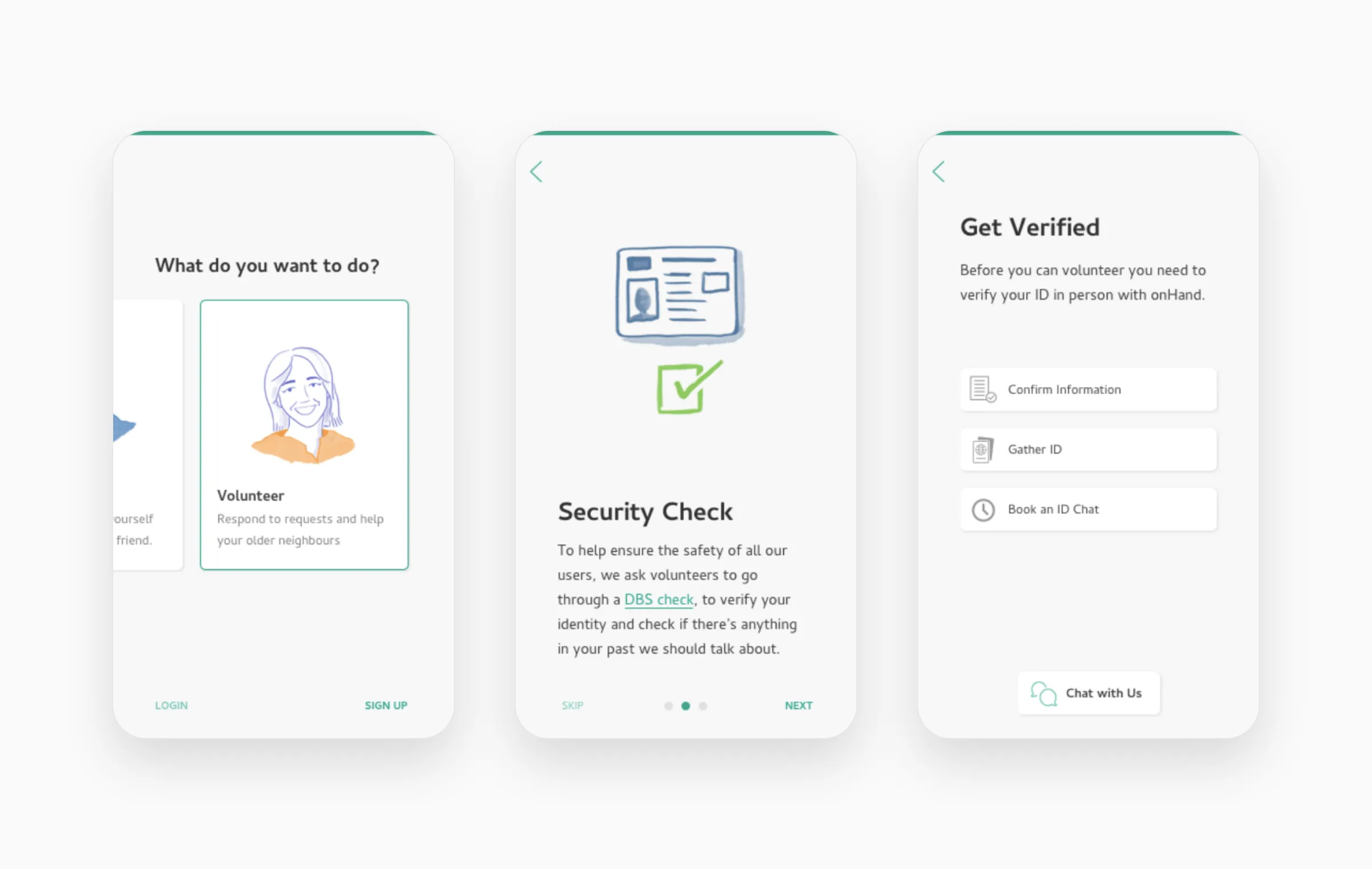
I built a security and safeguarding explainer that told people plainly why we ask for a DBS check and a one-to-one interview, and reassured them that being smaller than the big charities didn’t mean being laxer about safety.
I added a referral route so the tech-comfortable children of older people (usually the first to notice a parent needs a hand) could book support on their behalf, which opened a whole new audience. And because it’s a two-sided marketplace, I designed two distinct onboarding journeys, one per side, so neither a volunteer nor a worried family ever felt dropped in the deep end.
What was mine, and the name that wasn’t
I owned the journey mapping, the UX, the content design and the art direction. The “fear of care” insight came out of collaborative research I was part of rather than something I can claim alone.
And I didn’t pick the name: I’d have gone with Alma, which was on the shortlist.
You can’t win them all.
Tools: Sketch, Invision.